
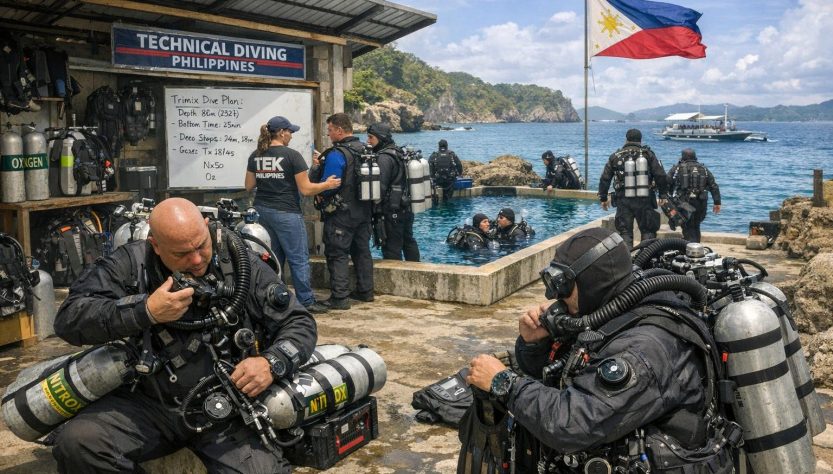
Divers’ Guide to Technical Diving Safety Protocols
Technical diving exposes participants to environments that exceed the limits of conventional recreational diving. These environments may include greater depths, overhead settings such as caves or wrecks, extended bottom times requiring staged decompression, or the use of gas mixtures other than compressed air. Because the margin for error narrows significantly under these conditions, safety protocols in technical diving are more structured, more redundant, and more rigorously applied.
Technical divers operate in situations where immediate ascent to the surface is often impossible or unsafe. As a result, divers must rely on precise planning, disciplined execution, and well-maintained equipment. Safety is not a single procedure but an integrated system that encompasses training, preparation, team coordination, gas management, and post-dive analysis.
Training and Certification
Technical diving begins with formal education. Divers must complete structured training programs through recognized certifying agencies before attempting any technical dive. These courses typically cover advanced dive theory, including hyperbaric physics, gas laws, oxygen exposure limits, decompression models, and human physiological responses to pressure changes.
In addition to theoretical knowledge, divers develop procedural discipline. Skills such as buoyancy control in multiple cylinders, valve shutdown drills, gas switching, decompression stop management, and emergency ascent protocols are practiced repeatedly under instructor supervision. Proficiency is measured not only by skill demonstration but by situational awareness and problem-solving ability under stress.
It is essential to never exceed your certification limits. Each certification level defines maximum depths, gas types, and decompression obligations. Progression into more advanced forms of technical diving should be incremental. Divers benefit from accumulating experience at each level before moving deeper or entering more complex environments.
Continuing education is equally important. Refresher training, scenario workshops, and participation in supervised dives help maintain competence. Skills that are rarely practiced degrade over time. Technical divers are expected to approach diving as an ongoing learning process rather than a static qualification.
Pre-Dive Planning
Planning is central to technical diving safety. Unlike recreational dives that may follow general guidelines, technical dives are executed according to clearly defined dive plans developed before entering the water.
A comprehensive dive plan includes target depth, expected bottom time, ascent schedule, decompression stops, gas switch points, and contingencies. Dive teams typically agree on turnaround pressures, maximum operating depths for each gas, and specific procedures for potential malfunctions.
Dive planning software and decompression planning tools are commonly used to calculate schedules with precision. Programs based on established decompression algorithms help divers evaluate different profiles and gas strategies. Examples of planning tools can be found through training organizations such as TDI or GUE.
Redundancy is built into planning. Divers calculate gas needs not only for the planned dive but also for emergency scenarios, such as sharing gas with a teammate or completing decompression after a failure. The dive plan should be reviewed and confirmed by all team members. Each diver must understand every stage of the profile rather than relying on one individual.
Environmental conditions also factor into planning. Currents, water temperature, visibility, surface support, and entry and exit points influence both equipment selection and gas consumption estimates. Planning includes assessing whether conditions align with training and experience levels.
Gas Management
Gas management is one of the most critical elements of technical diving protocol. Because technical dives frequently involve staged decompression and greater distances from the surface, divers cannot depend on a single cylinder or unrestricted ascent.
Gas calculations are performed according to established rules, often incorporating a reserve sufficient for two divers to exit the dive safely on one diver’s supply. For overhead environments, this may involve rule-of-thirds or other conservative distribution strategies. For open-water decompression dives, calculations account for ascent, stops, and emergency sharing.
Different phases of the dive may require different breathing mixtures. Trimix, a blend of oxygen, helium, and nitrogen, reduces nitrogen narcosis and oxygen toxicity risk at depth. Nitrox mixtures with elevated oxygen levels may be used during decompression to accelerate inert gas elimination.
Each cylinder must be analyzed, labeled clearly with oxygen percentage and maximum operating depth, and verified by the diver who will use it. Misidentification of a gas can result in oxygen toxicity or hypoxia. For this reason, double-checking regulator setups and test-breathing all tanks prior to the dive is standard practice.
Divers must confirm that regulators are assigned to the correct gases and that hoses are routed predictably. Standardized configurations reduce confusion during gas switches. Gas switch procedures are deliberate and communicated to teammates to prevent errors.
Equipment Check and Configuration
Technical diving equipment emphasizes redundancy and accessibility. The configuration must allow divers to identify, deploy, and manage equipment efficiently, even in low visibility or high-task-load scenarios.
A complete pre-dive equipment check includes verification of cylinder pressures, regulator function, buoyancy compensator inflation and deflation, dry suit integrity if applicable, dive computer settings, and backup instrumentation. Technical divers typically carry at least one backup mask, cutting tools, and redundant buoyancy or gas delivery systems.
Ensure that each piece of equipment functions correctly before entry. Valve drills may be performed on the surface to confirm accessibility and proper operation. Computers must be programmed for the correct gas mixtures and decompression settings.
Standardization improves safety. Teams often adopt consistent hose routing, regulator placement, and cylinder positioning. This allows teammates to anticipate where equipment is located in an emergency. Consistency across dives reduces cognitive load during critical moments.
Regular maintenance is essential. Regulators should be serviced according to manufacturer recommendations. O-rings, hoses, inflators, and valves should be inspected for wear. Technical divers frequently dive in demanding conditions, including cold water and overhead environments, which accelerate equipment stress.
Dive Execution
Once underwater, execution of the plan becomes the primary focus. Deviations from the dive plan should occur only when required for safety and should be communicated clearly among team members.
Depth, time, and gas consumption must be monitored continuously. Divers use reliable dive computers and often carry backup timing devices. Maintaining awareness of decompression obligations is especially important, as missed stops significantly increase decompression stress.
Teams follow predetermined communication protocols. Hand signals, light signals, or touch contact in low visibility maintain coordination. Divers stay within close proximity to ensure rapid assistance if required.
A reference to monitor depth and time regularly underscores the importance of disciplined tracking throughout the dive. Awareness minimizes the likelihood of exceeding maximum operating depths or remaining longer than planned at depth.
Buoyancy control and trim play a significant role in safety. Stable positioning prevents silt disturbance in overhead environments and reduces exertion. Efficient propulsion conserves gas and limits carbon dioxide buildup, which can exacerbate narcosis and stress responses.
If environmental changes occur, such as unexpected currents or visibility reduction, the team may decide to modify or terminate the dive. Adhering to conservative decision-making criteria helps prevent escalation of minor issues into major emergencies.
Decompression Procedures
Decompression is a defining aspect of many technical dives. During ascent, inert gases absorbed at depth must be eliminated gradually to minimize the formation of bubbles within body tissues.
Divers follow ascent rates specified in their plan or dive computer. Rapid ascents increase the probability of decompression sickness (DCS). Stops at predetermined depths allow controlled off-gassing. Gas switches to higher oxygen mixtures may occur at specific depths to accelerate decompression while remaining within safe oxygen exposure limits.
Accurate buoyancy control is critical during stops. Divers must maintain consistent depth, often within a narrow margin, despite changes in buoyancy as gas is consumed. In open water, ascent lines or staged cylinders may serve as visual and physical references.
Missed or shortened decompression stops carry measurable risk. If a stop is interrupted due to equipment problems or environmental factors, divers should follow established contingency procedures and monitor for symptoms after surfacing.
Emergency Preparedness
Technical divers prepare for emergencies through both equipment redundancy and procedural rehearsal. Redundant gas supplies, dual regulators, and backup computers allow continued operation after certain failures.
Valve shutdown drills enable divers to isolate a malfunctioning regulator. Gas-sharing procedures are practiced to ensure controlled ascent while managing decompression obligations. In overhead environments, lost line drills and zero-visibility exit simulations reinforce navigation under stress.
Surface support plays an important role. A comprehensive first-aid kit and emergency oxygen unit should be readily available. Oxygen administration is the primary first response for suspected decompression illness. Access to emergency medical services and knowledge of the nearest recompression facility are part of responsible planning.
Coordination with boat crews or shore teams ensures that someone on the surface understands the dive plan, expected return time, and emergency signals. Clear communication channels reduce response time if assistance becomes necessary.
Post-Dive Protocol
Post-dive procedures are an extension of safety management rather than an afterthought. After surfacing, divers should evaluate their physical condition and remain attentive to unusual symptoms. Hydration and rest contribute to recovery after decompression stress.
Dive computers and planning software allow analysis of the actual dive profile. Reviewing depth curves, ascent rates, and stop adherence provides insight into performance. Identifying discrepancies between planned and actual execution strengthens future planning.
Equipment should be rinsed, inspected, and stored properly. Any malfunction or irregular behavior should be addressed before the next dive. Component failures often reveal early warning signs that can be detected during post-dive inspection.
A structured debrief among team members supports continuous improvement. The discussion typically covers gas usage accuracy, communication clarity, environmental challenges, and procedural discipline. Constructive analysis enhances team performance over time.
Technical diving offers access to environments that require precision and accountability. By integrating structured training, meticulous planning, disciplined gas management, standardized equipment configuration, controlled decompression, and consistent post-dive review, divers create a systematic framework for safety. This framework reduces preventable risk and supports informed decision-making in demanding underwater conditions.