
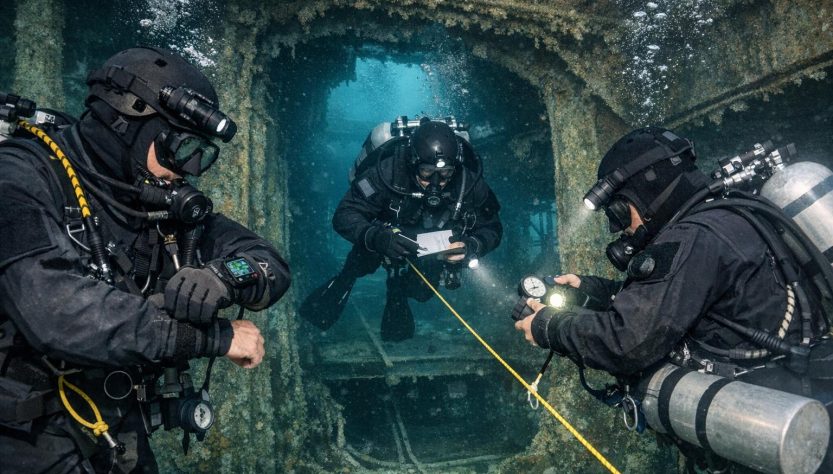
Understanding Rebreather Diving
Rebreather diving is a specialized form of underwater breathing technology that differs substantially from conventional open-circuit scuba systems. In an open-circuit system, a diver inhales compressed gas from a cylinder and exhales it directly into the surrounding water in the form of bubbles. In contrast, a rebreather is designed to recycle the diver’s exhaled gas. Carbon dioxide is removed through a chemical filtration process, and oxygen is replenished to maintain a breathable mixture. The same breathing gas is circulated repeatedly within a closed or semi-closed loop.
At the core of a rebreather system is a scrubber canister filled with a carbon dioxide absorbent material, commonly known as sorb. As the diver exhales, the gas passes through this material, which chemically binds carbon dioxide. Sensors monitor oxygen levels within the breathing loop, and the system injects oxygen automatically or manually to maintain a target partial pressure. By controlling oxygen levels precisely, rebreathers enable divers to optimize gas mixtures throughout the dive.
The ability to recycle gas offers several operational advantages. Gas consumption is reduced because only the oxygen metabolized by the diver and small amounts of diluent gas are used. This efficiency permits extended bottom times compared to open-circuit scuba, particularly at greater depths where gas density increases and consumption accelerates. In addition, the absence of continuous bubble exhaust creates a quieter underwater presence.
Rebreathers are associated with technical diving, scientific research, military operations, and specialized recreational exploration. Their complexity requires careful training and maintenance. Unlike open-circuit systems, where many issues are immediately detectable through obvious symptoms such as free-flowing regulators or empty cylinders, rebreather malfunctions can be subtle. For this reason, operational discipline and redundancy are central to safe use.
Operational Principles and Gas Management
Effective use of a rebreather involves understanding the relationship between depth, pressure, and gas composition. Oxygen becomes toxic if its partial pressure is too high, and hypoxia may occur if it is too low. Rebreather divers set a target oxygen partial pressure appropriate for the planned depth profile. Electronic systems monitor this level through multiple sensors to provide redundancy and cross-verification.
Diluent gas—often air, trimix, or heliox—is used to maintain appropriate gas density and manage loop volume as the diver descends. As ambient pressure increases with depth, the volume of breathing gas decreases in accordance with basic gas laws. Divers manually add diluent to maintain comfortable breathing volume. During ascent, excess gas is vented from the loop to prevent overexpansion.
Temperature also plays a role in performance. The chemical reaction that removes carbon dioxide generates heat and moisture, which can make breathing gas warmer than that supplied by open-circuit scuba. However, the efficiency of the scrubber material declines over time. Scrubber duration is calculated conservatively, and divers track usage to avoid exceeding manufacturer recommendations.
Redundancy systems are standard. Independent bailout cylinders containing open-circuit gas are carried in case the rebreather fails or the diver must exit the loop. Many divers also use independent displays for oxygen monitoring to reduce reliance on a single electronics platform. The technical discipline associated with rebreather diving reflects the importance of anticipating potential failure modes and planning for contingency responses.
Advantages of Rebreather Diving in Remote Locations
Remote diving environments often present logistical constraints. Locations such as isolated archipelagos, polar regions, or offshore seamounts may require transportation by small aircraft or liveaboard vessels with limited cargo capacity. Transporting multiple high-volume compressed gas cylinders in such circumstances can be costly and complicated. Rebreathers address this constraint by dramatically reducing gas consumption. A relatively small supply of oxygen and diluent can support multiple long-duration dives.
Extended bottom time is particularly relevant in remote scientific or exploratory expeditions. When travel to a site requires significant resources, maximizing productive time underwater becomes a priority. Rebreathers allow divers to remain at depth longer while maintaining optimized decompression strategies. By controlling oxygen partial pressure throughout the dive, decompression obligations may be managed more efficiently than with fixed open-circuit gas mixtures.
The minimal bubble output of a closed-circuit rebreather has practical implications in fragile ecosystems. Marine species that are sensitive to noise and vibration may respond differently to divers who do not emit continuous streams of bubbles. Underwater photographers and marine biologists often note that fish and other wildlife exhibit less avoidance behavior in the presence of bubble-free divers. This characteristic can facilitate more accurate observation and documentation.
Reduced gas release also has environmental implications. Although the impact of recreational diving bubbles is generally limited, avoiding unnecessary gas discharge contributes to a lower operational footprint. In caves, under ice, or within confined overhead environments, absence of rising bubbles prevents silt disturbance from overhead surfaces, preserving visibility and site integrity.
Types of Rebreathers
Rebreathers are broadly categorized into Closed Circuit Rebreathers (CCR) and Semi-Closed Rebreathers (SCR). Each system type has distinct operational characteristics and training requirements.
Closed Circuit Rebreathers (CCR) are fully sealed systems that recycle nearly all exhaled gas. Oxygen is added to maintain a preset partial pressure, and no routine gas is vented except during ascent or loop management. Because oxygen levels are actively controlled, CCR units permit precise optimization of breathing gas throughout the dive profile. This capability is especially valuable in deep technical diving, cave penetration, or mixed-gas exploration. The complexity of CCR systems necessitates in-depth training, routine calibration of sensors, and disciplined pre-dive checks.
Semi-Closed Rebreathers (SCR) recycle a portion of exhaled gas while continuously adding a fixed or variable flow of fresh gas. A small amount of gas is vented into the environment during operation. SCR systems are generally mechanically simpler than CCR units and may rely less heavily on electronic control. Oxygen levels are influenced by depth and diver workload rather than constant electronic setpoints. Although they do not offer the same level of gas optimization as CCR systems, SCR units can still provide substantial gains in gas efficiency compared to open-circuit scuba.
Selection between CCR and SCR typically depends on dive objectives, available logistical support, and diver training background. Technical expeditions requiring significant decompression or depth often favor CCR systems, whereas certain scientific and military applications have historically used SCR technology for robustness.
Preparing for a Rebreather Dive Trip
Preparation for a remote rebreather expedition involves equipment, training, logistics, and medical planning. Each component requires systematic attention well before departure.
Training and Experience: Rebreather operation demands formal instruction from qualified agencies and instructors. Courses progress from entry-level certification on a specific unit to advanced training in decompression procedures, mixed-gas use, and rescue techniques. Divers traveling to remote areas should have recent and relevant experience on the exact model of rebreather they intend to use. Skill degradation over time can affect response to high-risk failure scenarios such as oxygen sensor malfunction or hypercapnia.
Equipment Maintenance: Because repair facilities may not be available in isolated locations, preventive maintenance is critical. Oxygen sensors have limited service life and should be replaced according to manufacturer guidelines. Batteries must be fresh and compatible with the unit’s electronics. O-rings, hoses, counterlungs, and mushroom valves require inspection for wear or contamination. Divers often carry spare components for essential systems, including mouthpieces, hoses, and displays.
Consumables and Logistics: Carbon dioxide absorbent material, oxygen cylinders, and diluent cylinders must be secured in advance. In some regions, sourcing high-purity oxygen can be challenging. Coordination with local dive operators or gas suppliers is advisable. Transport regulations for compressed gases vary by country, particularly for air travel. When transport of filled cylinders is restricted, divers may arrange rental or on-site filling services.
Medical Preparedness: Remote expeditions increase the importance of emergency planning. Divers should assess proximity to recompression chambers and evacuation options. Insurance coverage tailored to dive incidents is prudent. A comprehensive first aid kit and oxygen administration equipment are standard components of expedition planning. Physical fitness and up-to-date medical screening reduce risk in demanding environments.
Effective preparation extends to documentation. Manuals, checklists, and contact information for technical support should be accessible in digital or printed format. Many manufacturers provide updates, user advisories, and technical bulletins through their official websites, such as AP Diving or Poseidon Diving Systems. Reviewing current guidance before travel supports informed decision-making.
Exploring Remote Dive Sites with Rebreathers
Remote underwater environments present diverse operational challenges. Cold-water regions, such as polar seas, require thermal protection and consideration of electronics performance in low temperatures. Batteries may discharge more rapidly in cold conditions, and regulators must be suitable for near-freezing water. Rebreathers used under ice demand reliable bailout strategies because direct ascent to the surface may not be possible.
Isolated Pacific atolls and offshore seamounts often feature strong currents and limited infrastructure. Here, rebreathers can extend exploration time along deep reef walls or pelagic drop-offs. Maintaining situational awareness is essential, as long bottom times may increase decompression obligations if depth limits are exceeded. Accurate dive planning software and conservative gradient factors are frequently used to manage decompression schedules.
Underwater caves and cenotes present overhead environments where bubble disturbance can dislodge sediment from ceilings. In these settings, the absence of exhaust bubbles improves visibility stability. However, cave diving on rebreathers requires dual redundancy in gas supply and navigation systems. Permanent guidelines, lighting redundancy, and strict adherence to penetration limits are standard practice.
Scientific divers employ rebreathers for behavioral studies of marine life. The absence of bubble noise and reduced gas movement may influence the proximity at which certain species permit observation. Researchers documenting marine mammals, reef fish, or invertebrate assemblages often rely on the extended presence made possible by efficient gas recycling.
For ongoing discussion of expedition logistics and operational techniques, divers consult professional communities and technical resources. Organizations such as TDI/SDI and Global Underwater Explorers publish training standards and safety materials relevant to rebreather operations in demanding environments. Reviewing case studies and incident analyses contributes to continuous improvement in practice.
In remote diving contexts, the benefits of rebreather technology depend on disciplined execution. The combination of extended endurance, optimized gas management, and reduced environmental disturbance makes rebreathers a practical tool for specialized exploration. However, these advantages are realized only when thorough preparation, conservative planning, and technical proficiency are maintained throughout the expedition lifecycle.